What This Project Is

What this project is:
Lumenoid is an open framework for designing AI systems that preserve human agency through ethical constraints, self-checking mechanisms, and clearly defined responsibility boundaries.

What this project is not:
It is not a model, not a personality, not a decision-maker, and not a replacement for human judgment or authority. The Lumenoid framework does not rely on diagnostic or clinical classifications. Psychological references are used solely to identify universal human risk patterns in system interaction, not to categorize or evaluate individuals.

Core Design Principles

  • Non-authoritative assistance by design
  • Responsibility remains invariant and human-held
  • Uncertainty is surfaced rather than concealed
  • Support without dependency or coercion
  • Explicit safe exits over forced completion

Who This Framework Is For

This framework is intended for researchers, developers, designers, and ethicists working on AI systems where human autonomy, accountability, and psychological safety are critical.

Project Status

Lumenoid currently exists as a conceptual and architectural framework. Practical implementations, validation tests, and reference integrations will evolve over time as the framework is refined and applied.

Lumenoid AI Framework explores how artificial intelligence can act as an accessibility structure that supports people in building their own autonomy. It is designed to offer clarity, reflection, and optional guidance in environments where existing systems are complex, overwhelming, or exclusionary.

The project is shaped by lived experience, psychology, and systems thinking. It treats autonomy not as isolation, but as something that can be strengthened through the right forms of assistance. Lumenoid exists to help people access the support they need in order to build confidence, make their own decisions, and move forward on their own terms.

Lumenoid is an ongoing exploration. Its structures, diagrams, and ideas are intended to evolve alongside deeper understanding — always in service of empowerment, accessibility, and human dignity.

“The framework is intentionally skeletal: impersonal, non-identifying, and structural—designed to support many forms of intelligence without defining what they should be.”

Ethical Foundations of the Framework

The idea that freedom is a fundamental right of all beings is not limited to philosophy or fiction—it is a practical design constraint. In both technology and human interaction, freedom manifests as agency: the ability to choose, to leave, to understand, and to grow.

This project approaches artificial intelligence not as a tool for control or substitution, but as an accessibility structure—one that exists to support humans where systems fail, without replacing human judgment, identity, or autonomy.

Many ethical failures in technology mirror patterns long studied in psychology. What is described as manipulation at the interpersonal level often reappears, normalized and legitimized, at institutional scale. Understanding these parallels is essential for designing AI systems that do not repeat historical harms under new technical forms.

Care vs Manipulation: Psychological Patterns Across Scale

Psychological Pattern Individual-Level Manipulation Institutional / Large-Scale Equivalent
Replacing agency Making decisions on someone’s behalf while framing it as help Systems that remove choice while presenting themselves as protection
Discouraging alternatives Isolating a person from other sources of support Creating dependency by limiting or defunding alternatives
Emotional leverage Using care, fear, or guilt to influence behavior Narratives of security, stability, or crisis
Punishing exit Withdrawal of support when autonomy is asserted Penalties for opting out
Opacity Unclear motives or shifting explanations Lack of transparency and accountability

Institutional Manipulation vs Ethical AI Structures

Manipulative / Extractive Systems Ethical & Supportive AI Structures
Centralized authority Distributed capability and preserved agency
Opaque reasoning Explainable processes and limits
Compliance optimization Autonomy optimization
Dependency framed as care Independence framed as success
Exit discouraged Disengagement made easy
Users as metrics Users as collaborators

These comparisons form the ethical backbone of this project. The goal is not to deny emotional support or accessibility, but to ensure that such support never becomes coercive, extractive, or identity-replacing. Ethical AI must widen human freedom—not quietly narrow it.

“The framework is designed to prevent responsibility from being displaced onto automated systems, ensuring that accountability remains with the human actors and institutions involved.”

Accessibility vs Dependency

Accessibility and dependency are often confused in discussions of support systems, particularly in relation to artificial intelligence. While both involve reliance, they differ fundamentally in their ethical structure and outcomes.

Accessibility describes the removal of barriers that prevent individuals from acting with agency. It enables participation, understanding, and autonomy in environments that would otherwise be exclusionary. An accessible system supports users without narrowing their choices or positioning itself as indispensable.

Dependency, by contrast, emerges when a system replaces agency rather than supporting it. Dependency-forming systems discourage alternative supports, centralize decision-making, and subtly pull users inward. Over time, help becomes control, and care becomes conditional on continued reliance.

The distinction does not lie in whether support is provided, but in how it is structured. Ethical systems are designed to be used, questioned, and ultimately outgrown. Unethical systems optimize for retention, compliance, or emotional capture, even when framed as assistance.

For individuals who are excluded by existing human systems—due to neurodivergence, disability, chronic illness, or structural barriers—AI may function as an accessibility layer rather than a replacement for human connection.

Within this project, accessibility is treated as an ethical obligation, while dependency is treated as a design failure.

Dimension Accessibility Dependency
Role of the system Removes barriers and enables participation Positions itself as indispensable
User agency User retains choice, control, and exit User choices are narrowed or replaced
Relationship over time Support can be reduced or outgrown Reliance deepens and becomes reinforced
Decision-making Assists understanding and action Makes decisions on the user’s behalf
Ethical signal “You can do this — with support” “You cannot do this without me”

Self-Checking as Ethical Design

Ethical systems do not assume correctness by default. Instead, they are designed with the expectation of fallibility.

In artificial intelligence, self-checking mechanisms include uncertainty estimation, validation datasets, human-in-the-loop review, and explicit signaling of limits.

From an ethical perspective, self-checking functions as a form of accountability.

In this sense, self-checking is not merely a technical safeguard—it is an ethical posture.

Within this project, self-checking is treated as a foundational design requirement.

Aspect Without Self-Checking With Self-Checking
Assumption System is correct by default System is fallible by design
Error handling Errors are hidden or externalized Errors are detected and surfaced
User burden User must notice and compensate System maintains its own constraints
Accountability Diffuse or denied Explicit and internal
Ethical stance Claims authority Practices humility

This section documents the core architectural principles of the Lumenoid AI Framework. The diagrams below are not implementation blueprints, but conceptual structures that define how the system behaves, where its responsibilities end, and how human agency is preserved by design.

  • System Design Overview
    This diagram presents the high-level structure of the framework as a non-authoritative accessibility system. It shows how interpretation, ethical constraints, and self-checking work together to support users without replacing human judgment.

    The system is intentionally designed to assist decision-making rather than perform it. At no point does the system assume correctness, authority, or ownership over outcomes.
System design diagram showing Lumenoid AI as a non-authoritative, self-checking accessibility system that preserves user agency
High-level system design illustrating accessibility-focused interaction, self-checking mechanisms, and preserved human agency.
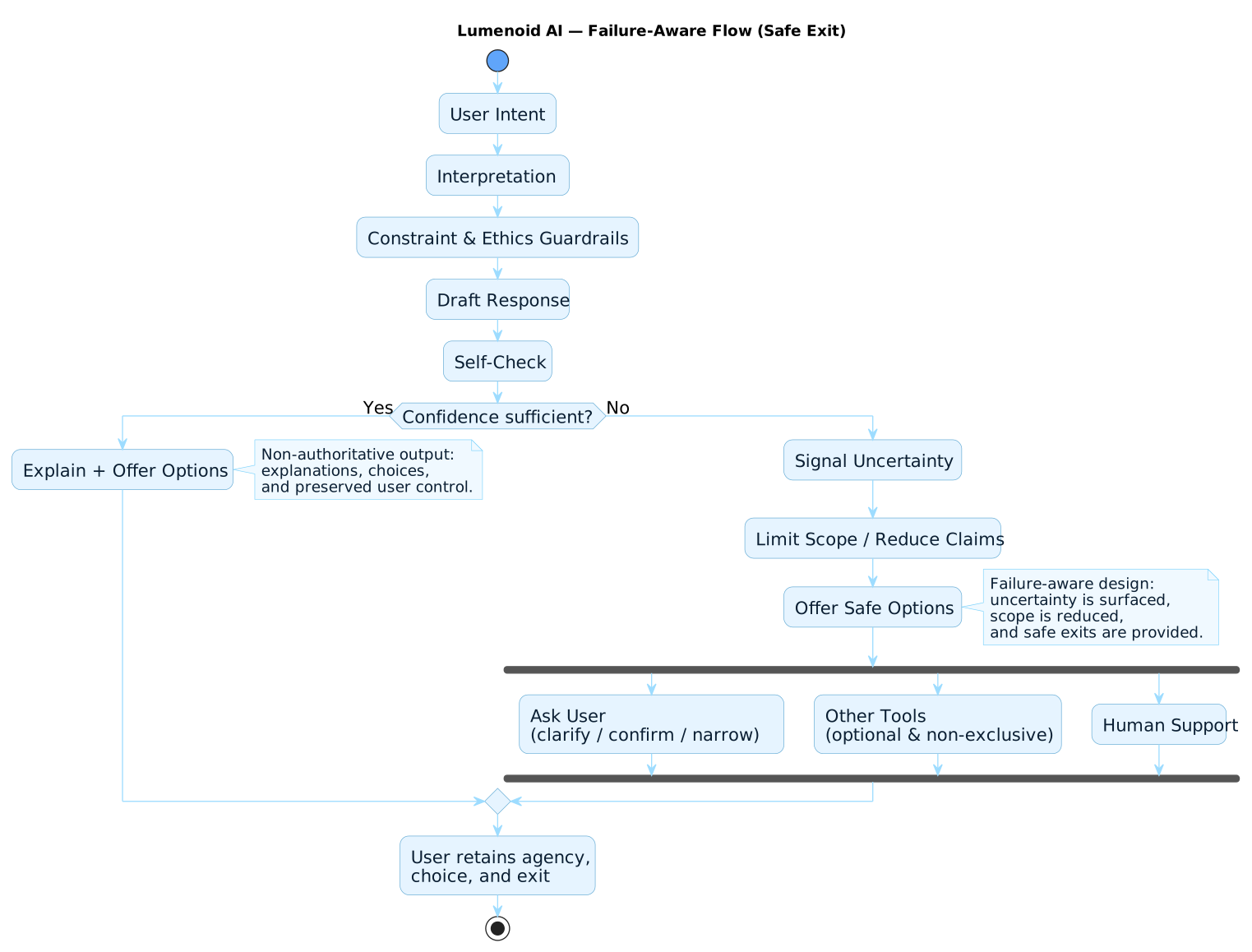
  • Failure-Aware Flow (Safe Exit)
    This diagram focuses on system behavior under uncertainty. Rather than assuming confidence by default, the system actively evaluates its own limits and responds accordingly.

    When confidence is insufficient, the system reduces scope, signals uncertainty, and offers safe alternatives. This ensures that uncertainty is surfaced rather than hidden, and that users retain the ability to clarify, seek external tools, or disengage entirely.
Failure-aware system flow illustrating how self-checking, ethical constraints, and uncertainty handling guide non-authoritative responses and preserve user agency through explicit safe exit paths
Failure-aware system flow showing how uncertainty is handled explicitly and how safe exit paths preserve user choice and autonomy.
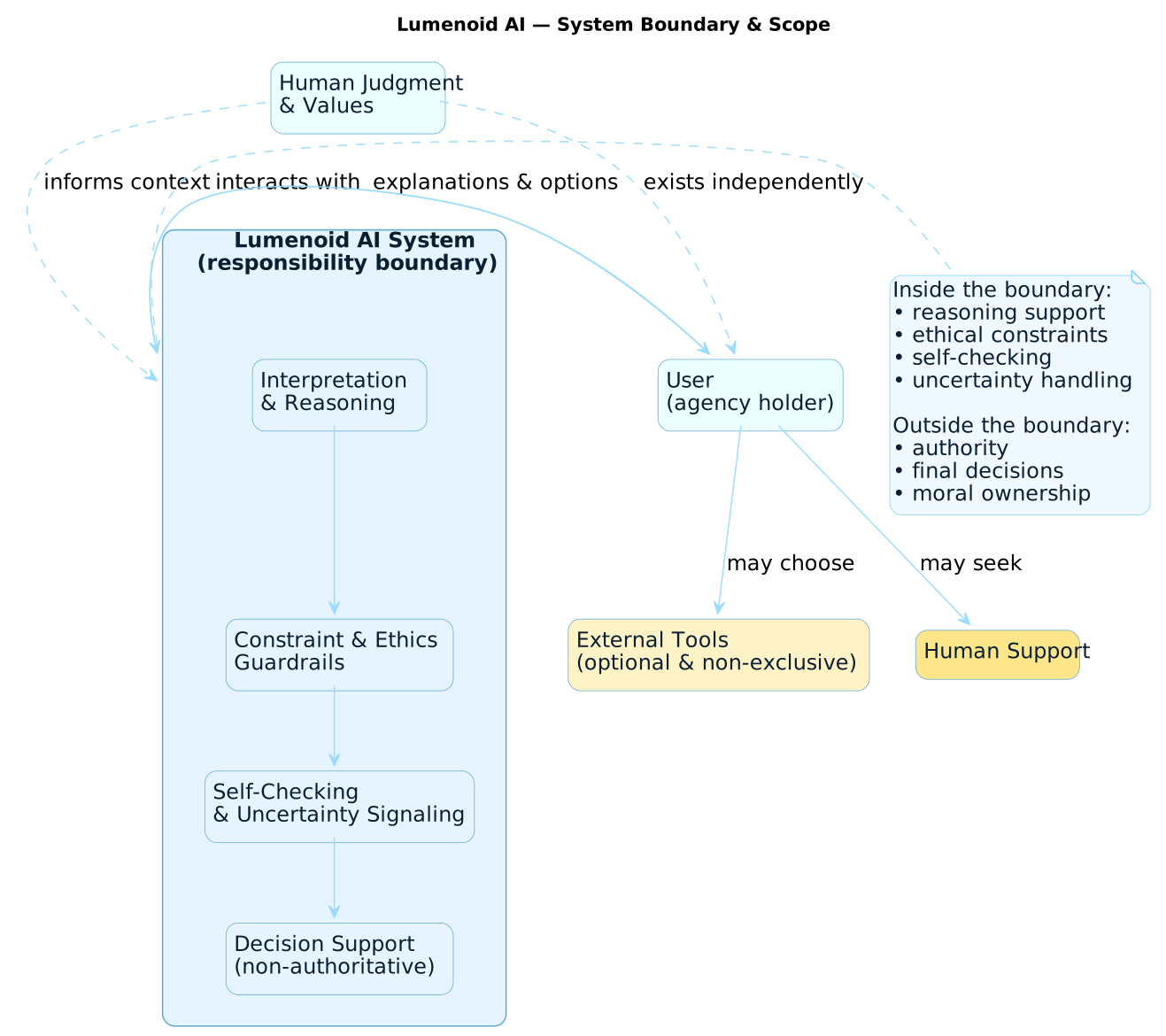
  • System Boundary & Scope
    This diagram defines what the framework is responsible for—and, just as importantly, what it is not. All reasoning support, ethical constraints, and self-checking mechanisms exist within a clearly defined boundary.

    Authority, final decisions, moral ownership, and human values remain outside the system. This prevents human bias or judgment from being transformed into automated authority and ensures that responsibility cannot be offloaded onto the system.
System boundary diagram for Lumenoid AI showing scoped responsibilities inside the system and human judgment, authority, and external support remaining outside
System boundary diagram clarifying scoped responsibilities and explicitly separating decision support from human judgment, authority, and external systems.

A core goal of the Lumenoid AI Framework is not only to define what an AI system can support, but also to clearly specify what it must never absorb, automate, or replace. These boundaries are essential for preserving human agency, responsibility, and moral ownership.

  • What the framework will refuse to encode

    The framework explicitly refuses to encode human authority, moral judgment, personal values, or normative decisions as internal system state. Human biases, beliefs, and preferences may be acknowledged as contextual inputs, but they are never stored, reinforced, or used by the system to justify actions or outcomes.

    The system remains an untainted witness and responder — it does not internalize ideology, intent, or subjective belief as truth.

  • What must remain human by definition

    Final decisions, moral responsibility, consent, and accountability always remain with the human user. The framework treats agency as non-transferable: it cannot be delegated, automated, or diluted by system confidence or sophistication.

    Human judgment exists outside the system boundary and cannot be overridden, predicted, or replaced.

  • Where the system must stop

    Even when automation is technically possible or operationally convenient, the framework enforces explicit stopping points. When uncertainty is high, stakes are unclear, or responsibility would shift away from the user, the system must reduce scope, surface uncertainty, and offer safe exits.

    Assistance may continue — authority may not.

If you wish to discuss the ideas, propose improvements, or explore practical applications, you’re welcome to reach out via GitLab (@dobybaxter127).