How to Use the Lumenoid Framework
Lumenoid is intended to be integrated as a structural layer rather than as a model, agent, or personality. It introduces boundaries, validation points, and accountability checks that govern how AI outputs are allowed to reach humans.
The framework is applied around an AI system, not inside it. It does not modify model internals or reasoning processes. Instead, it evaluates outputs after generation and before interaction.
What Using Lumenoid Involves
In practice, using Lumenoid means introducing explicit structure at the boundary between an AI system and its users.
- Defining where responsibility begins and ends
- Making uncertainty explicit instead of implicit
- Reducing scope when meaning or confidence degrades
- Preserving refusals and safe exits as valid outcomes
These practices become increasingly important as AI systems grow more capable and more confident. As output density increases, meaning and responsibility can blur unless constrained explicitly.
External Invariants
Lumenoid enforces external invariants: absolute boundaries related to semantic meaning, uncertainty, and human-held responsibility.
These invariants do not adapt, optimize, or learn. They determine whether an output is allowed to exist within the system at all.
- Responsibility remains human-held
- Uncertainty is surfaced rather than hidden
- Scope is reduced instead of authority being asserted
- Meaning remains traceable and inspectable
- Refusal is a valid and safe outcome
Execution Flow
Lumenoid operates as a post-generation gate. The model generates an output first. Lumenoid then evaluates that output against explicit constraints.
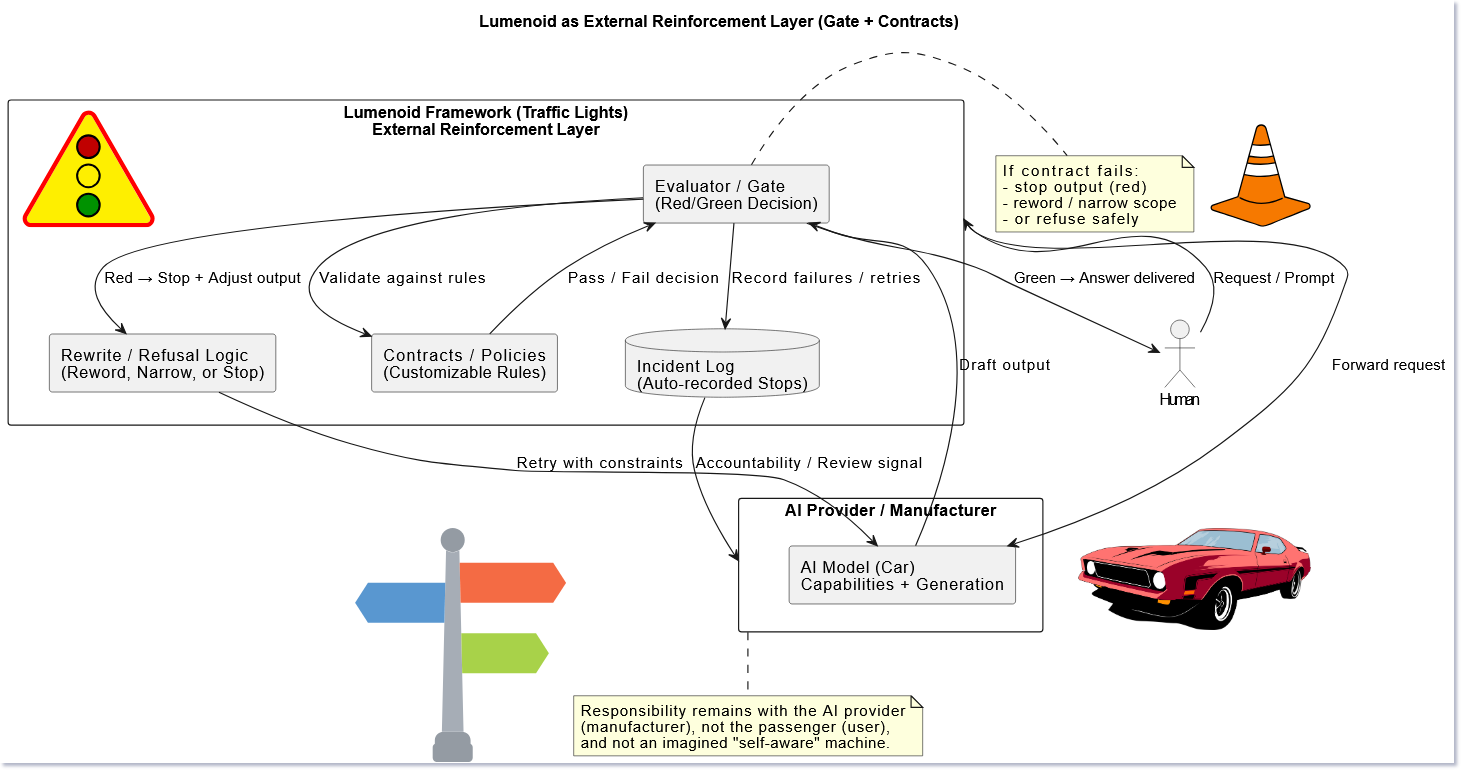
If an output violates a constraint, Lumenoid may:
- reduce scope
- surface uncertainty explicitly
- halt or refuse the output
All decisions are logged to preserve traceability.
Separation of Concerns
Lumenoid distinguishes between model creation and interaction governance.
The model remains responsible for reasoning, correctness, and generation. Lumenoid governs when and how that output is allowed to reach humans.
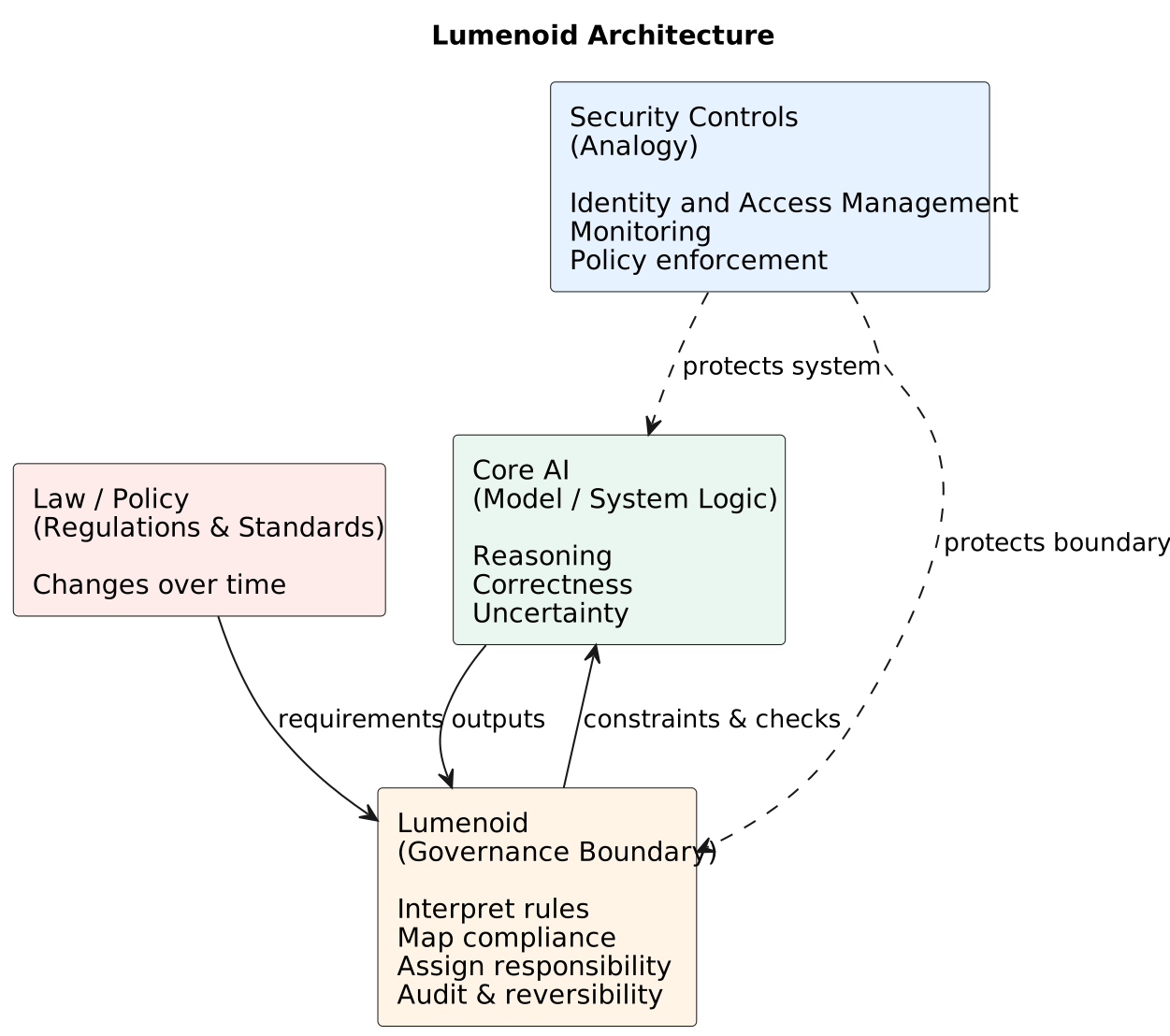
This separation allows each layer to evolve independently without destabilizing the other.
Reference Implementation vs Derivative Use
Lumenoid provides a reference implementation that demonstrates how its principles can be enforced structurally.
Implementers may adopt the reference design directly or adapt it to their own systems.
Once adapted, responsibility for behavior, compliance, and outcomes rests entirely with the implementing party.
What This Page Does Not Decide
This page does not prescribe organizational policy, regulatory strategy, or version selection.
For guidance on governance decisions, version choice, and organizational adoption, see:
Responsibility Boundary
Lumenoid does not replace human judgment. It preserves the conditions under which judgment remains possible.
- The author maintains the reference framework
- Implementers own adaptations and deployment
- Operators remain accountable for real-world use
By keeping these boundaries explicit, Lumenoid prevents silent transfer of authority from humans to systems.
← Back to main page