Psychological Foundations of the Framework
This page outlines the psychological and cognitive foundations that inform the Lumenoid AI Framework. It describes how humans perceive, trust, and interact with complex systems, and why preserving agency, responsibility, and uncertainty awareness is central to the framework’s design.
It examines perception, trust, uncertainty, and responsibility in human–system interaction, and explains why preserving agency is essential to ethical design.
Lumenoid AI — Psychology, Engineering, and Responsibility
Lumenoid AI is founded on the principle that artificial intelligence is not an autonomous force, but a human-engineered system whose behavior emerges from explicitly defined intent, structure, and constraints. Fear-driven narratives arise when complexity is mistaken for agency and opacity for independence. In reality, risk does not originate from AI itself, but from missing semantic boundaries, weak validation, and loss of traceability as systems scale.
Lumenoid restores the correct order by placing human psychology and intent first, translating them into formal representations, and enforcing them through transparent, testable, and observable code. By preserving meaning across every layer—from cognition to implementation—the framework functions as a safety container that keeps accountability legible, responsibility human, and interaction with AI governed rather than mythologized.
By restoring responsibility to its proper place, Lumenoid reframes technological risk as a matter of human design, deployment, and governance rather than inevitability or contagion. Artificial intelligence does not emerge spontaneously nor propagate without intent; it is created, distributed, and operated through deliberate human and institutional choices.
Inclusion is not a value statement. It is a structural capability.
Lumenoid extends this principle beyond technology and into ethics itself. Ethics are not treated as value statements, intentions, or declarations of awareness, but as structural capabilities.
When inclusion exists only at the level of language—while underlying structures remain rigid— the system externalizes its limits onto the individual. This is not an ethical failure at the interpersonal level. It is an architectural failure.
From a psychological perspective, harm does not primarily arise from ill intent, but from sustained exposure to systems that demand performance beyond a nervous system’s sustainable capacity. When participation requires continuous adaptation, masking, or self-depletion, responsibility is silently shifted away from the system and onto the individual.
Lumenoid explicitly rejects this transfer. A system cannot claim ethical grounding if it requires harm in order to function. Inclusion, safety, and care exist only where variability is structurally anticipated, recovery is permitted without negotiation, and responsibility remains traceable to design decisions rather than absorbed by those most affected.
Structural Degradation of Responsibility in Complex Systems
Responsibility loss in institutional and technical systems typically occurs through a gradual progression. Each stage appears locally rational, while cumulatively producing harm that becomes difficult to correct or attribute.
| Stage | Framing | Structural Characteristics | Accountability State |
|---|---|---|---|
| 1. Innocent Ignorance | “We’re trying something new.” | Genuine uncertainty, untested assumptions, real complexity. Questions are allowed and limits can still be named. | Responsibility is present but incomplete. Errors are plausibly unintentional. |
| 2. Incentivized Blindness | “We don’t need to slow down.” | Time, money, or political pressure discourages deeper understanding. Admitting uncertainty is framed as risk or obstruction. | Responsibility begins to erode as ignorance becomes rewarded. |
| 3. Defensive Abstraction | “The system decided.” | Decisions are attributed to abstractions such as models, processes, or policy. Human authorship disappears behind procedure. | Accountability is no longer directly attributable. This is the first ethical red line. |
| 4. Normalized Harm | “This is just how it works.” | Failures repeat predictably, the same populations are harmed, and complaints are reframed as misuse or resistance. | Ignorance is no longer credible. Leadership is informed and outcomes are measurable. |
| 5. Strategic Concealment | “We never promised that.” | Metrics are selectively reported, failures are buried, and automation is framed opportunistically. | Responsibility is deliberately displaced downward. Negligence has transitioned into manipulation. |
| 6. Sacrificial Correction | “We need to restructure.” | Workers are dismissed, teams dissolved, and individuals blamed while underlying structures remain unchanged. | Authority is preserved while accountability is avoided. |
When “We Didn’t Know” Stops Being Credible
| Signal | Observed Pattern | Implication |
|---|---|---|
| Repetition | The same failure occurs repeatedly, in the same way, affecting the same groups. | Knowledge exists regardless of acknowledgment. |
| Raised Warnings | Staff, users, or researchers report harm without corrective action. | Ignorance has expired as a defense. |
| Selective Complexity | Simple language is used when promoting the system, complexity is invoked only when assigning blame. | Responsibility is being strategically obscured. |
| Non-attribution | No accountable human decision-maker can be named. | Accountability has been designed away. |
| Forbidden Fixes | Mitigations exist but are blocked by policy or declared out of scope. | Harm is being chosen over resolution. |
| Externalized Costs | Authority remains centralized while workers and users absorb harm. | The system is protecting itself rather than learning. |
Treating AI as an autonomous or viral force obscures accountability and fuels unnecessary fear, whereas Lumenoid treats complexity as a signal for stronger instrumentation, clearer interfaces, and more rigorous semantic containment. Uncertainty is therefore not a reason for panic, but an invitation to inspect, validate, and correct. Central to this approach is the continuous translation of human psychological models into enforceable engineering constructs. Through explicit typing, semantic annotations, validation layers, and carefully designed tests, Lumenoid ensures that meaning is not lost as systems evolve.
These tests are not static safeguards, but living instruments—refined over time to reflect new knowledge, new failure modes, and new social contexts. Fine-tuning, monitoring, and iterative validation allow misuse, drift, or abuse to be detected early, contained effectively, and traced precisely through the system’s decision pathways. By making behavior observable and intent traceable, Lumenoid enables responsibility to remain actionable beyond the technical domain. When misuse occurs, it can be attributed not to an abstract system, but to concrete design decisions, deployment choices, and governance failures.
This clarity allows legal, ethical, and regulatory frameworks to function as intended—holding actors, organizations, and institutions accountable rather than deflecting blame onto the technology itself. In this way, Lumenoid does not deny risk; it makes risk governable, interpretable, and correctable, ensuring that technological power remains aligned with human values, human law, and human responsibility over time.
Misplaced vs Correct Model of Responsibility
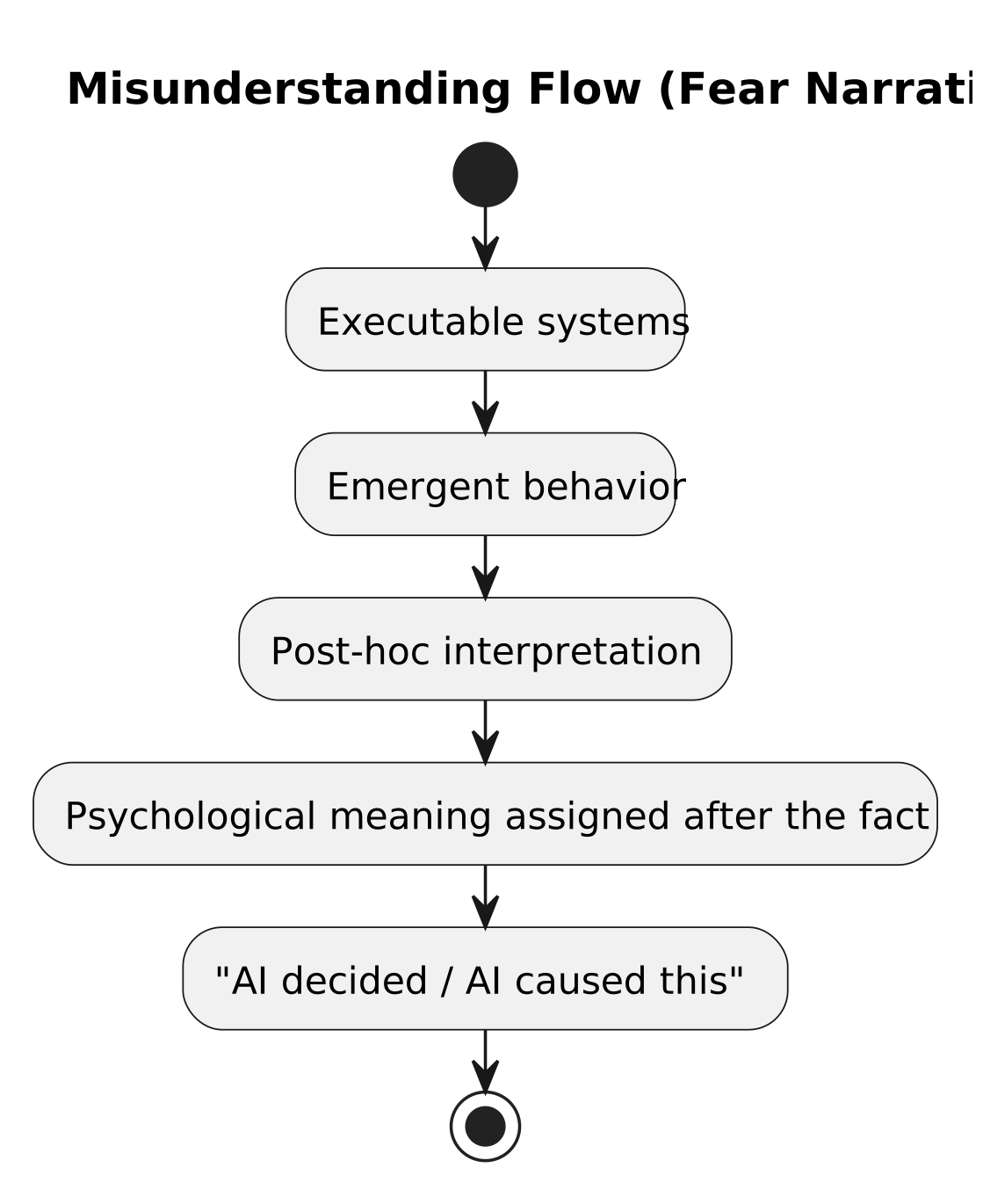
Responsibility assigned after execution, leading to fear and misplaced agency.
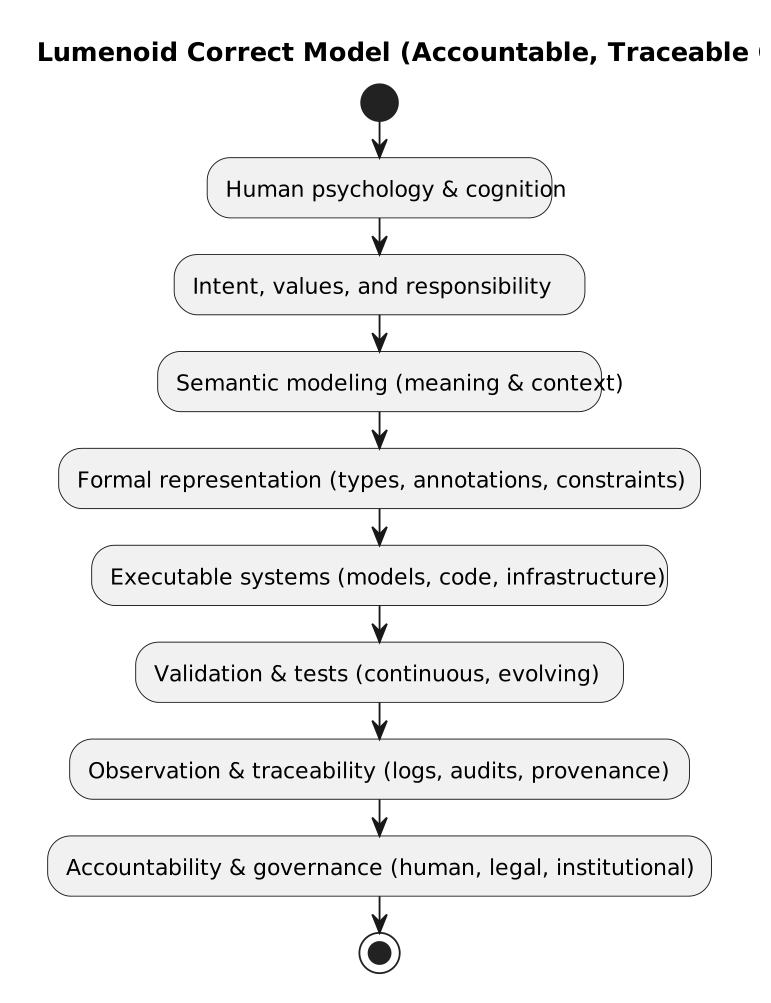
Intent and meaning precede execution, preserving traceability and human accountability.
Mapping the Lumenoid Framework to Modules and Durability Over Time
- Human psychology & cognition → Lumenoid.Psychology
- Intent, values, responsibility → Lumenoid.Intent
- Semantic modeling (meaning & context) → Lumenoid.Semantics
- Formal representation (types, constraints) → Lumenoid.Contracts
- Executable systems → Lumenoid.Execution
- Validation & tests (continuous) → Lumenoid.Validation
- Observation & traceability → Lumenoid.Observability
- Accountability & governance → Lumenoid.Governance
Durability Over Time
Lumenoid’s durability does not come from predicting future technologies, but from enforcing invariants that remain valid regardless of scale:
- Intent always precedes execution
- Meaning is preserved before automation
- Responsibility is never inferred post-hoc
- Validation evolves continuously
- Outcomes are always traceable to human decisions
Core Lumenoid Invariant
No system behavior exists without a traceable human path of intent, representation, execution, and accountability.